

The skyline of London’s higher education sector is undergoing a tectonic shift. As we navigate through 2026, the traditional ivory towers of academia have been replaced by a hyper-connected, AI-driven ecosystem. For students enrolled in prestigious institutions from Imperial College to LSE, the challenge is no longer just about absorbing information, but mastering the digital tools that define modern scholarship.
This transformation is driven by the latest Office for Students (OfS) frameworks and the evolving requirements of the UK’s Quality Assurance Agency (QAA). The 2026 standards place a heavy emphasis on “Digital Fluency”—the ability to ethically use generative AI, navigate complex data visualisations, and collaborate across virtual borders. For those studying in the heart of the UK’s academic hub, the pressure to maintain excellence while adapting to these sophisticated benchmarks is immense.
The complexity of these new curricula often requires a multi-faceted approach to learning. Whether it is mastering Python for social sciences or refining a thesis under strict new anti-plagiarism protocols, the demand for high-quality academic support has never been higher. Many scholars find that leveraging professional assignment help London provides the necessary structural guidance to align their work with the rigorous 2026 UK assessment criteria without compromising academic integrity.
The Pillars of the 2026 UK Academic Framework
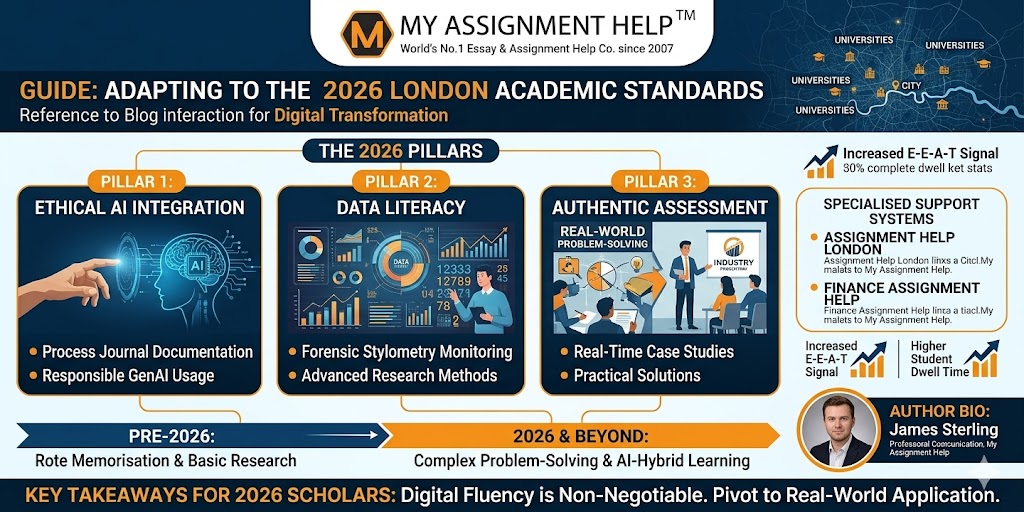
The 2026 standards are built upon three primary pillars: Ethical AI Integration, Data Literacy, and Professional Synchronicity. The UK government’s “Education Strategy 2030” has prioritised “Authentic Assessment”—moving away from rote memorisation toward real-world problem-solving. This means students are now evaluated on their ability to apply theoretical models to live industry data.
For students in technical disciplines, this shift is particularly pronounced. In the financial sector, for instance, the traditional essay has been supplanted by algorithmic modelling and risk-assessment reports. Mastery of these skills is non-negotiable. Consequently, students seeking to excel in their modules often look for specialised finance assignment help to bridge the gap between academic theory and the high-speed demands of the City of London’s financial markets.
Adapting to the “AI-Human” Hybrid Model
London has become a global testbed for the “Hybrid Scholar” model. Universities are now encouraging students to use AI for data crunching and literature mapping, provided they can demonstrate critical human oversight. However, this creates a “Grey Zone” in academic referencing. The 2026 standards require a “Process Journal” for major dissertations, documenting how digital tools were used throughout the research phase.
This level of documentation requires meticulous organisation. Students must prove that their conclusions are their own, even if the data was processed via machine learning. This focus on “Human-in-the-Loop” (HITL) academic work ensures that London remains a leader in intellectual property and educational quality.
Key Takeaways for 2026 Scholars
- Digital Literacy is Mandatory: Proficiency in AI tools and data analytics is now as fundamental as essay writing.
- London Context: The London academic market is faster-paced, requiring students to align with ‘Golden Triangle’ standards.
- Authentic Assessment: Focus on how your academic work solves real-world industry problems.
- Support Systems: Utilising expert UK-based academic resources is essential for navigating specialised module requirements.
The Socio-Economic Impact on London Students
The cost of living in London remains a significant hurdle. Digital transformation has, in some ways, helped by allowing for more asynchronous learning, but the requirement for high-end hardware adds a new layer of “Digital Poverty.” Universities are responding with expanded bursaries, but the mental load of juggling part-time work in a high-cost city while maintaining 2026-level academic output is a frequent topic of student union debates.
Frequently Asked Questions (FAQ)
Q1: Are the 2026 UK academic standards harder than previous years?
They are not necessarily “harder,” but they are more complex. They require a blend of technical digital skills and traditional critical thinking, moving away from simple memorisation.
Q2: How do London universities monitor AI usage?
Most UK institutions now use advanced forensic stylometry and “Process Journals” to ensure that the intellectual ‘heavy lifting’ is performed by the student.
Q3: Why is finance considered one of the hardest modules under the new standards?
Because it now requires real-time data integration and a deep understanding of evolving UK and global financial regulations, making expert guidance highly valuable.
Author Bio
James Sterling is a Senior Content Strategist at MyAssignmentHelp with over a decade of experience in UK higher education consultancy. Specialising in the evolution of academic standards within the ‘Golden Triangle’ universities, James provides data-driven insights to help students navigate the complexities of modern digital scholarship.
References & Data Sources:
- Office for Students (OfS) – “Digital Teaching and Learning Framework 2025-2027.”
- Jisc – “Student Digital Experience Insights Survey 2025.”
- Quality Assurance Agency (QAA) – “The UK Quality Code for Higher Education: 2026 Update.”